
The Efficiency Trap: Why Your Brain Loves Autopilot

Have you ever driven all the way home only to realize you don’t remember the last five miles? Or perhaps you’ve tackled a recurring problem at work using the exact same spreadsheet template, even when the data felt like it didn't quite fit?
That is your brain being remarkably—perhaps dangerously—efficient. Our brains are energy-hungry organs. To conserve resources, the brain has a natural tendency to automate behavior when encountering frequently occurring situations. In the world of problem-solving and decision-making, this automation is a survival tactic. Instead of burning mental fuel on "how" to do something, your brain creates a shortcut.
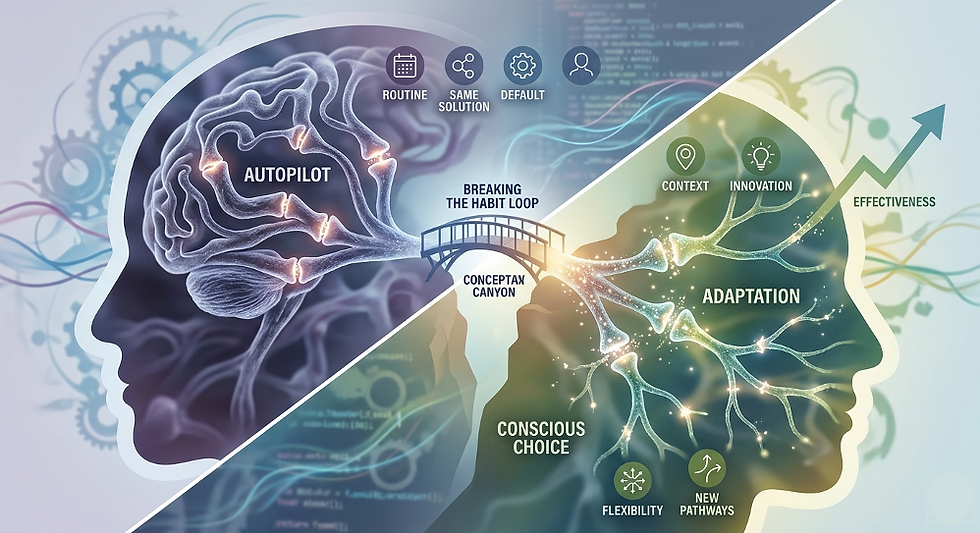
The Biology of the "Groove"
This process isn't just psychological; it’s deeply physical. When we repeat a behavior, the synapses (the connections between neurons) strengthen. Think of it like walking through a grassy field: the first time is difficult, but after a hundred trips, you’ve worn a clear, effortless path.
The heavy lifting of this automation happens in the basal ganglia, a group of subcortical nuclei responsible for motor control and executive functions, but most famously known as the brain's "habit center." While the prefrontal cortex—the logical, "thinking" part of your brain—is busy focusing on new challenges, the basal ganglia quietly takes over the routine tasks, locking them into a loop of cue, routine, and reward.
The Comfort of the Familiar
As our need for efficiency leads toward the formation of habits, we often find ourselves "stuck." We become comfortable with habitual behavior because it feels safe and requires less effort. This is fine for brushing your teeth or making coffee, but it creates a significant hurdle in professional environments.
We become emotionally and cognitively attached to our "default settings." When a familiar problem arises, we reach for the familiar tool, even if that tool has become blunt over time.
The Workplace Challenge: Context is King
At the modern workplace, the "field" we are walking through is constantly changing. A strategy that worked for a small team in 2022 might be a disaster for a global department in 2026. This is where behavioral adaptation becomes your most valuable asset.
The difficulty lies in the "habit break." Because those neural pathways are so well-worn, trying to act differently feels physically and mentally taxing. It triggers a sense of friction, making us want to retreat back to what we know.
Why Adaptation Trumps Automation
Why is it so important to break the cycle?
Contextual Accuracy: No two situations are identical. Adapting your behavior allows you to read the room, the market, or the specific nuances of a project rather than applying a "one size fits all" solution.
Innovation: Habits are the enemies of "thinking outside the box." If you are on autopilot, you are incapable of seeing a third option that might be more effective than the two you’ve always used.
Leadership Growth: Effective leaders aren't just experts; they are chameleons. They know when to be directive, when to be collaborative, and when to step back.
Breaking the Loop
Breaking a habit isn't about willpower; it’s about rewiring. It requires bringing the behavior back from the basal ganglia to the prefrontal cortex.
Identify the Cues: Notice what triggers your "default" response.
Introduce Friction: Make it slightly harder to do the habitual thing and easier to do the new thing.
Value Flexibility over Comfort: Remind yourself that the goal isn't to be fast; it's to be effective.
In the end, efficiency is a tool, not a destination. By understanding how our brains seek the path of least resistance, we can consciously choose to step off the worn path and forge a new one that actually leads where we need to go.


Comments